Summer of Woman Suffrage! Week 4

During our fourth week of our Summer of Woman Suffrage we will take a look at the League of Women Voters (LWV) both nationally and our very active local branch here in Williamstown. Thanks to historian @Barbara Winslow and Anne Skinner, current president of the Williamstown League, for their help and enthusiasm.

Learn more about the information shared here by reading Barbara Winslow’s article, “The League of Women Voters: A Century of Voter Engagement,” published by the The Gilder Lehrman Institute of American History

Read the full article: https://tinyurl.com/y2v6q9rb

Barbara Winslow is professor emerita of history at Brooklyn College. An authority on women’s activism, she is the founder and director emerita of The Shirley Chisholm Project. She is the author of Clio in the Classroom: A Guide for Teaching US Women’s History (Oxford University Press, 2009) and Shirley Chisholm: Catalyst for Change (Westview Press, 2013). With Julie A. Gallagher, she is the co-editor of Reshaping Women’s History: Voices of Nontraditional Women Historians (University of Illinois Press, 2018).


Here Winslow provides us with an overview and an introduction to the League:

“The League of Women Voters was founded in 1920 by American suffragists, just months before the ratification of the Nineteenth Amendment gave women the constitutional right to vote after more than seventy years of struggle.

Over the past one hundred years the League, following in the progressive politics of its mother organization, the National American Woman Suffrage Association (NAWSA), has been an influential and powerful women’s coalition.

An activist, grassroots organization, the League believes that citizens should play a critical role in civic advocacy. Its founders believed that maintaining a nonpartisan stance would protect their fledgling organization from becoming mired in the party politics of the day. However, League members were encouraged to be political themselves by educating citizens about, and lobbying for, governmental and social reform legislation.

The League’s accomplishments, failures, challenges, and ups and downs reflect the trajectory of US reform politics, class and racial conflicts, and the ebb and flow of women’s and feminist movements.”

National League of Women Voters, September 17, 1924. (National Photo Company Collection, Library of Congress).

The 19th amendment.

The national League of Women Voters (LWV) was born with a sense of urgency, mission, and apprehensive optimism.

The genesis of the League was in the West. In 1909, at the NAWSA convention in Seattle, Washington, suffragist Emma Smith DeVoe (1848-1927) proposed a national league of women voters. The conference rejected the motion. After Washington State voted to enfranchise women, DeVoe organized the National Council of Women Voters, a nonpartisan coalition of women from voting states.

Emma Smith DeVoe by James & Bushnell, ca. 1915. (Prints and Photographs Division, Library of Congress).

Prior to the 1919 NAWSA convention in St Louis, the association’s president, Carrie Chapman Catt (1859-1947), began negotiating with DeVoe to merge her organization with a new league that would be the successor to NAWSA. As fifteen states had already ratified the Nineteenth Amendment, NAWSA wanted to move forward with a plan to educate women on the voting process and further their participation in the political arena.

Carrie Chapman Catt, ca. 1908. (Carrie Chapman Catt Papers, Library of Congress)

The formal organization of LWV was drafted at the February 1920 National American Woman Suffrage Association (NAWSA) convention held in Chicago. For one year, the League was a committee of NAWSA before it became its own independent entity.

Not all NAWSA members supported the formation of the League. Some argued that since NAWSA’s goal of securing the vote was accomplished, NAWSA could be disbanded. Others were concerned that an independent organization of women might create dissension within and take women out of the existing political parties. Others were mindful of the growing conservative climate that was hostile to any form of radicalism, including feminism.

Catt promised that this new organization would be “a living memorial . . . dedicated to the memory of our brave departed leaders, to the sacrifices they made for our cause.” A League, she continued, was necessary so that women could “use their new freedom to make their nation safer for their children and their children’s children.”

From “The League of Women Voters: A Century of Voter Engagement.” by Barbara Winslow, published by The Gilder Lehrman Institute of American History

Read the full article: https://tinyurl.com/y2v6q9rb

“What should be done, can be done; what can be done, let us do.” – Carrie Chapman Catt

After the League of Women Voters (LWV) was formally organized in February 1920, Maud Wood Park was elected the first president. The League’s first major legislative victory was the passage of the Sheppard-Towner Act of 1921, which provided federal funds for maternity and child welfare.

Portrait of the National League of Women Voters’ board of directors, including Maud Wood Park and Carrie Chapman Catt, taken during its Chicago Convention in 1920.

The League’s platform was ambitious and progressive, advocating, for example, support for the Cable Act supporting independent citizenship for married women, which became law in 1922, ensuring that a woman’s citizenship did not rely on the status of her husband’s citizenship.

File Photo by Library of Congress Mrs. Maud Wood Park extending her thanks to Congressman James R. Mann, for his part in pushing the Woman’s Suffrage Constitutional Amendment through the House of Representatives.

The League also sponsored a “get out the vote” campaign and called for legislation supporting collective bargaining, child labor laws, a minimum wage, a state employment service, and compulsory public education.

By 1924 there were national branches in 346 of 433 congressional districts. One of the branches founded in 1924 was here in Williamstown.

The League of Women Voters continued its progressive legislative agenda throughout the decades. Its membership declined during the 1929−1940 Depression…But the League remained committed to progressive legislation, supporting most of the policies and proposals initiated by Franklin Roosevelt’s New Deal.

Celebrating the 10th anniversary of the LWV in 1930.

From its inception, the League was internationalist. Its founding members had been involved in a wide range of global suffrage, temperance, peace, and social welfare organizations. In the 1920s the LWV supported the League of Nations. In the 1930s it warned of the dangers of fascism, supported Roosevelt’s Lend Lease, the war aims of World War II, and, postwar, the United Nations. Harry Truman invited the League of Women Voters to serve as a consultant to the US delegation at the United Nations Charter Conference in 1945. To this day, the League maintains its presence at the United Nations through its one official and two alternate observers.

President Harry Truman invited the League to serve as a consultant to the U.S. delegation at the United Nations Charter Conference.

In the post–World War II era, the League of Women Voters began to make serious changes in its activities and policies. The civil rights, women’s, and social justice movements galvanized the League’s reassessment.

As early as the 1950s state chapters began to challenge restrictive voter registration laws. While much attention has been given to the racist voting laws in the southern states, northern states’ voter laws were also reprehensibly restrictive. In the 1950s the New York State League of Women Voters mounted a campaign called Permanent Personal Registration (PPR) to make voter registration easier. The New Yorker described this campaign as “the greatest political effort since the fight for woman’s suffrage.” As of 1960, in New York State one had to pass an English written and oral literacy test and provide proof of an eighth-grade education. The League fought against these racist and xenophobic restrictions.

The postwar women’s movement changed the League’s membership and political direction. It had to compete for members and political influence with organizations such as the National Organization for Women (NOW). The League reversed its position on the ERA and, after 1974, became a major partner with NOW in championing the amendment.

The LWV sponsored the United States presidential debates in 1976, 1980, and 1984, but pulled out in 1988 after refusing to go along with the demands of the major candidates’ campaigns.

The League continues to provide voters with nonpartisan information about federal, state, and local candidates as well as information on the political issues of the day.

The League of Women Voters’ membership has tripled since 2016; it now has more than 500,000 members in approximately 700 state and local organizations. It is still overwhelmingly white and middle class, but more working women are members. Especially in urban areas, the League chapters make attempts at diversity.

While still nonpartisan, the League champions a very progressive agenda including support for reproductive rights, gun safety, abolition of the death penalty, universal health care, childcare, enforcement of the EPA, and legislation combating climate catastrophe; it opposes racial profiling and economic, racial, and gender inequality. The League is also committed to universal suffrage. It opposes voter suppression in any and all forms, Citizens United, and gerrymandering; it supports federal legislation guaranteeing every eligible voter the right to vote as well as voting rights for those incarcerated and for those out of prison.

While it is a very different organization today than the one founded in 1920, the twenty-first-century League of Women Voters has fulfilled much of its century-old mission.

“Vote” LWV poster c 1920 by Louis Bonhajo.

“Our Turn” LWV poster c 2018 by Laura Champion from Lafayette High School.

Learn more about the information shared here by reading Barbara Winslow’s article, “The League of Women Voters: A Century of Voter Engagement,” published by the The Gilder Lehrman Institute of American History

Read the full article: https://tinyurl.com/y2v6q9rb

Barbara Winslow is professor emerita of history at Brooklyn College. An authority on women’s activism, she is the founder and director emerita of The Shirley Chisholm Project. She is the author of Clio in the Classroom: A Guide for Teaching US Women’s History (Oxford University Press, 2009) and Shirley Chisholm: Catalyst for Change (Westview Press, 2013). With Julie A. Gallagher, she is the co-editor of Reshaping Women’s History: Voices of Nontraditional Women Historians (University of Illinois Press, 2018).

As a community, Williamstown was anti-Suffrage, but once the 19th amendment was ratified and the League of Women Voters was established in 1920, the women of the town were fairly quick to form a LWV branch. Founded in 1924, the Williamstown League is now one of the oldest in the state as earlier branches have gone by the wayside.

“We are a grassroots organization,” Anne Skinner, a long-time League member and its current President explained. “The programs that we support come from the opinions of the members of the league. You’re not just paying your dues, you pay your dues and then you think about the issues.”

Voter education is a high priority, and it is League members who hand out the “I Voted” stickers as you exit the polls, although they haven’t been able to this year. Skinner reminded all voters that the primary for state offices is on September 1st. “It’s very early this year, and the League is urging people to vote by mail.”

LWV members holding a Voter Registration Drive at BCC in 2015

The Williamstown League has proudly hosted candidate forums over the years to enable residents to get to know candidates on both sides of the aisle and the issues. “We’re very proud of our non-partisanship and we don’t endorse candidates or issues we haven’t studied,” Skinner said. “We also hold two ballot question issue forums every election cycle, one for the questions we support and one for those we don’t.”iBerkshires photo of Anne Skinner introducing Paul Caccaviello, Judith Knight and Andrea Harrington, the 2018 candidates for Berkshire County District Attorney, at a League sponsored forum.

Last June League members helped plant a tree outside the Milne Public Library Williamstown in honor of Massachusetts ratifying the 19th amendment in June 1919. “Our tree and its plaque are just to the left of the Library entrance and it is thriving.”

Service berry tree in bloom in 2020, one year after planting

Continuing that celebration, about 70 Williamstown League members, all dressed in white, marched in last year’s 4th of July Parade. “We got shortchanged because we couldn’t march this year in honor of the League’s 100th anniversary, but we will celebrate the 101st in style next year,” Skinner proclaimed. “We want to get young people carrying signs saying ‘I’m going to vote in 2024.'”

League members Barbara Winslow, Bette Craig, and Carrie Waara making posters for the 2019 4th of July parade.

iBerkshires photo of Williamstown LWV members marching in the 2019 4th of July Parade.


Thanks to Gene and Justyna Carlson of the North Adams Museum of History & Science for providing this program from the 1913-1914 North Adams Equal Suffrage League. The quotations are particularly interesting.

And thanks to Anne Crider for the following information on the League: “The North Adams Equal Suffrage League existed for 14 years before it disbanded in August of 1920. It was formed by Katherine Millard, who was chosen as president and held the position for the entire time the League existed. Another active woman in the League was Mrs. Condit W. Dibble.”


Discover Historic Williamstown! Week 4
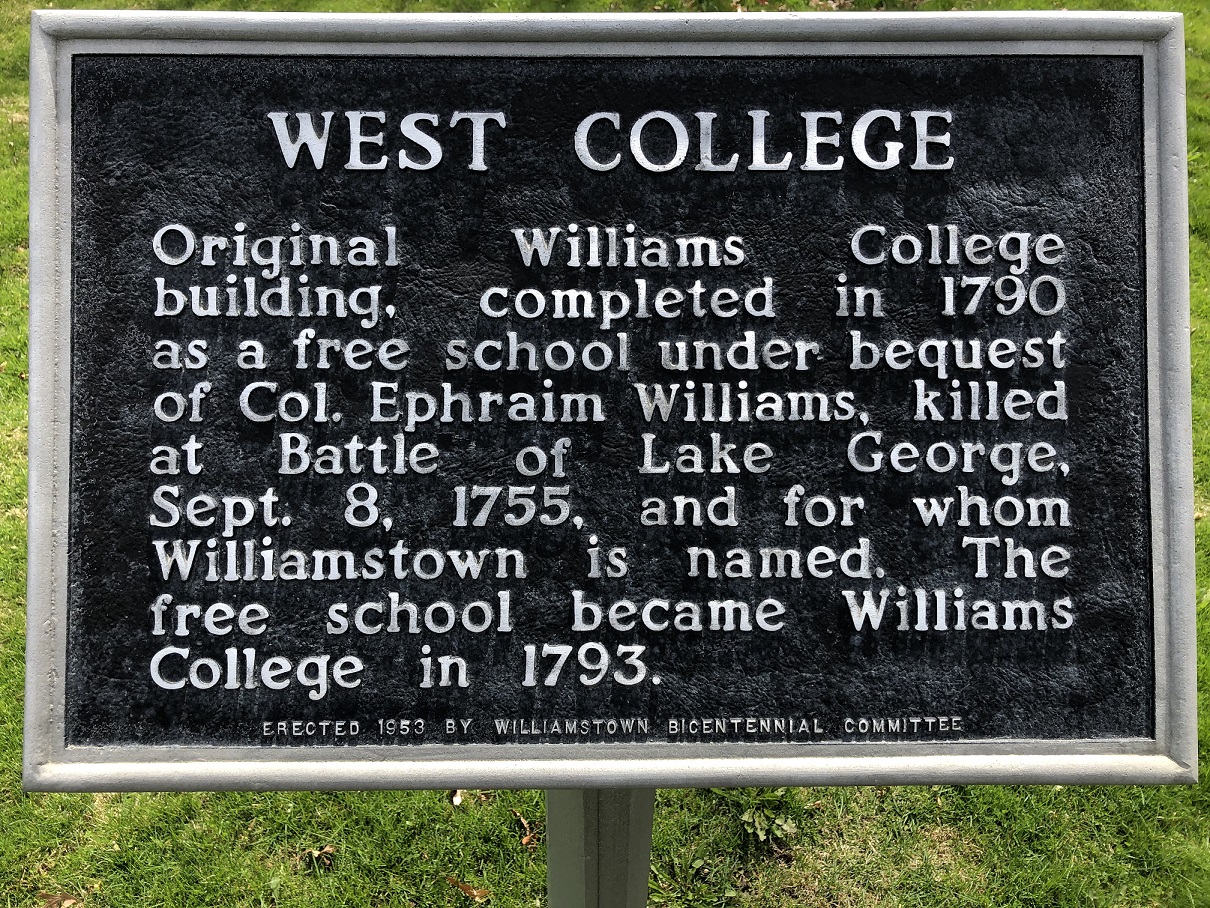
Discover Historic Williamstown!  Week 4

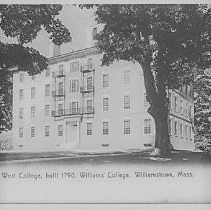
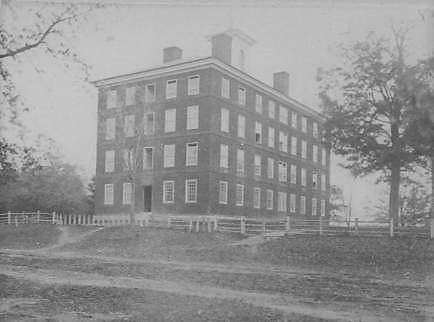
This week’s site is easy to find.  West College was the original building housing the Free School donated to the town in Ephraim Williams’ will, which became Williams College in 1793. You will find it on Main Street, across from the Williams College President’s house.

In this photo, c. 1850, you are looking from the east toward West College, from somewhere between Water Street and Spring Street from the north side of Main Street.

The Free School was conceived by Colonel Ephraim Williams, and described in his will for the direct benefit of the children of the soldiers who had served under him in one or other of the forts of the old French line.

The nine trustees empowered to establish the Free School in Williamstown met for the first time on April 24, 1785, in Pittsfield, and discovered that the $9,157 left by Williams’ was in no way sufficient.

In August, the Building Committee suggested that the “old lime-kilns” where Griffin Hall was eventually sited in 1828, would be a good location for the school, but the protruding rocks were deemed too difficult to level, as indeed they eventually proved to be.

A site directly across Main Street to the south, where the college built their second building in 1797, was also considered. But eventually the Committee decided on the site “south of William Horsford’s house” where General Sloan eventually built the house that has been home to the presidents of Williams College since 1858.

At the second meeting of the trustees, in August 1785 the trustees set out the dimensions of the building, but by May of 1788, when the following plans were announced, nothing had been built. Finances, clearing and leveling rocks, siting a sufficient well, and dealing with a lawsuit brought by the citizens of Adams [now North Adams], claiming that Williams’ had also intended that a Free School be erected in their community, were among the issues causing delay.

“That the house for the use of the Free School in Williamstown be constructed of brick, and be of the following dimensions, namely, seventy-two feet in length and forty feet in breadth, from inside to inside, three stories in height, with four stacks of chimneys and a bevel roof ; that said house be erected on the eminence east of the meeting-house, and south of Mr. William Horsford’s dwelling-house, on the south side of the highway; — provided the sum of five hundred pounds be paid or secured to be paid, to the said Corporation for the use of the said School.”
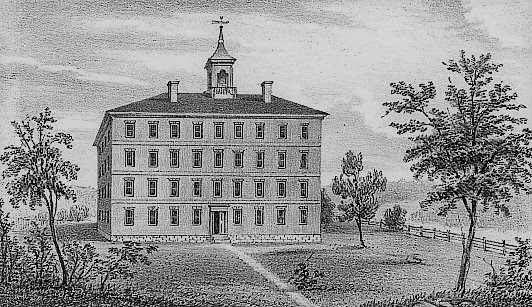
Finally, on May 26, 1790 the trustees voted: Taking into consideration the importance and necessity of erecting without delay the building intended for the use of said school ; and Colonel [Tompson Joseph] Skinner having this day engaged to sink the well already begun, and partly dug, on the western eminence where the house was ordered…to be placed, and to level the said western eminence sufficient to accommodate the building,— do resolve, that the committee appointed to superintend and direct in the erection of said building shall proceed to set up said building, on said eminence, without delay.”

The trustees, in their 1792 Petition to the General Court of Massachusetts, describe West College as “a large and convenient brick building within the said town of Williamstown, with lodging and study rooms sufficient to accommodate one hundred students, besides a common School-room sufficient for sixty scholars, a Dining room that will accommodate one hundred persons, a Hall for public academical exercises, and a Room for a library, apparatus, &c., the whole being nearly finished.”

David Noble donated a bell, which was rung to signal chapel, study hours, recitations, and evening prayers.

In 1793 the cupola and the top floor were finished, the hall divided by a partition “so as to make two rooms for the Students,” and a lightning rod was added.

Although the interior of West College has been reconstructed due to fire and various renovations, the shell of the building is original.


Where’s the water?

West College never had a well of its own, and never enjoyed a legal right of access to any neighboring well, although the Whitmans (successors to William Horsford) by courtesy allowed its roomers for considerable stretches of time to use the old well. There are two copious natural springs not very far apart from each other on the low ground to the southeast of the West College, from one or other of which the students supplied themselves for the most part till the middle of the nineteenth century.

When [Arthur Latham Perry, Williams class of 1852] as a freshman became a roomer in West College in 1848, there was a well-worn path diagonally across what was then called “Deacon Skinner’s meadow” on which there was not then a building of any kind, leading to what has now long been called the “Walden Spring.” At the same time there was opened a new and narrow street directly down to this spring southerly from Main Street, and consequently named “Spring Street.”
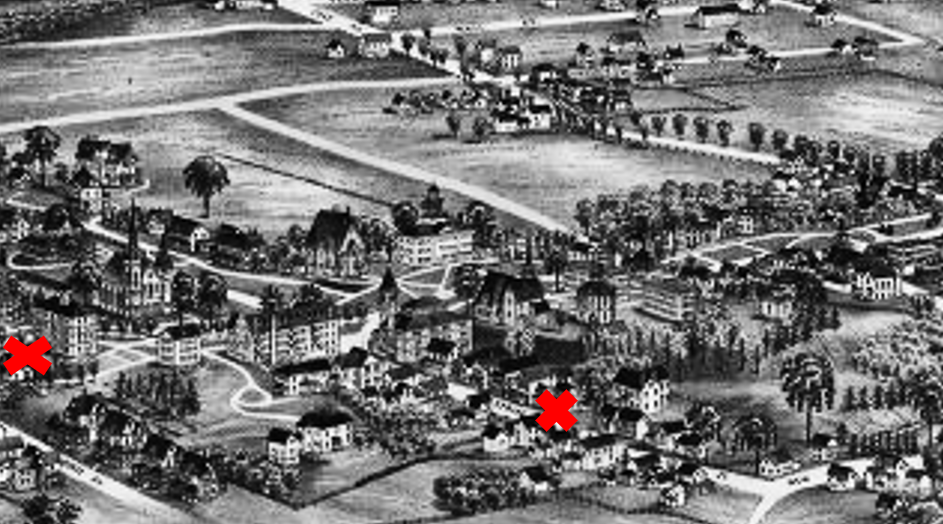
This 1889 Burleigh Lithograph of Williamstown shows West College (red x at far left) and Spring Street (red x near center). Remnants of the “diagonal path” between the two can still be seen here.

About the middle of the [19th] century… the Williamstown Water Company brought water from the “Cold Spring” to the village residences and near to the college buildings.
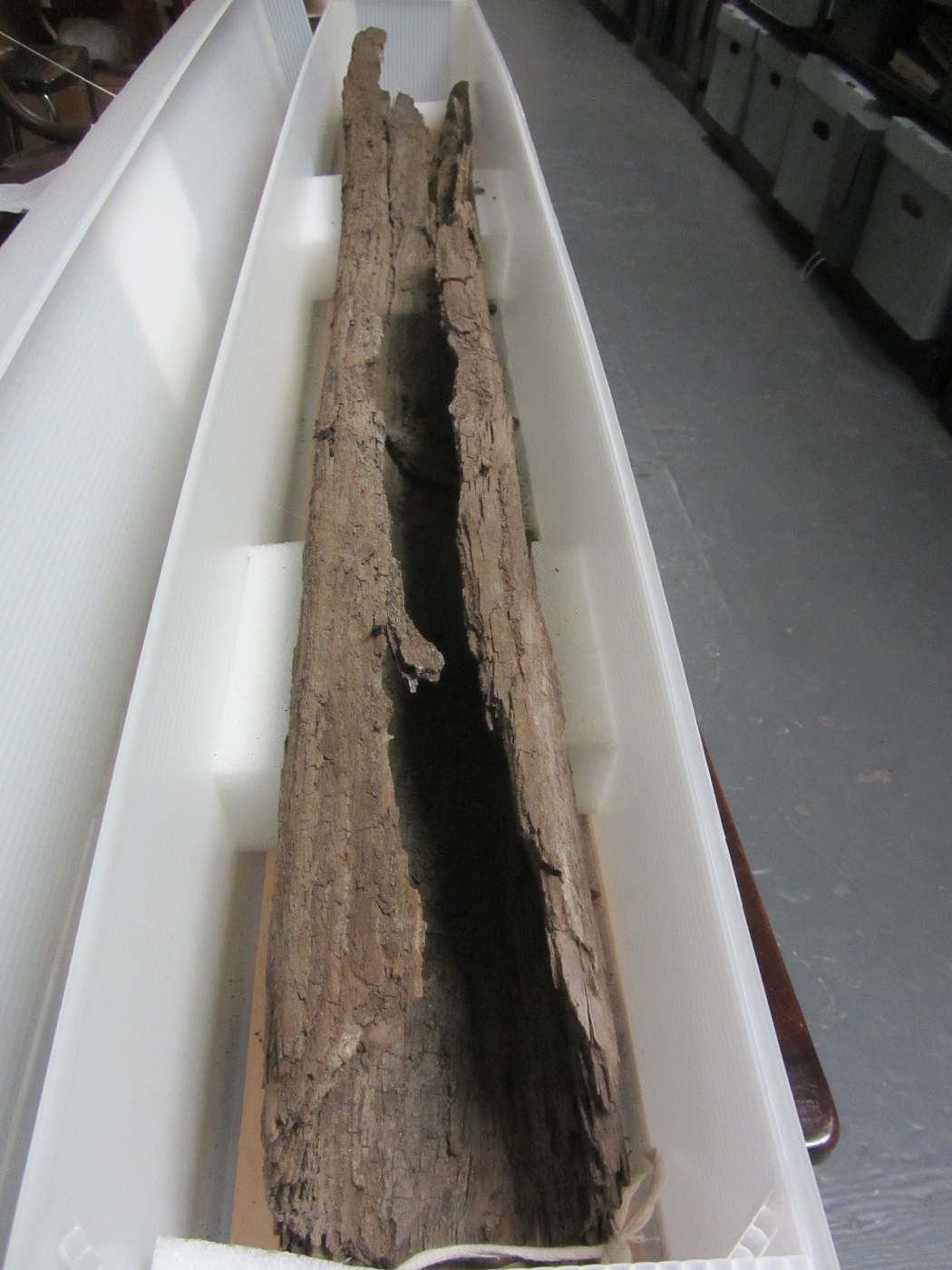
This wooden water pipe, shaped like a railroad tie with a hole bored through the center, is likely from the first set of pipes carrying water from Cold Spring into town. Wooden pipes were replaced by iron pipes in 1876.


What do we know about the Free School that existed in the West College building from 1790-1793?

Two departments of instruction were established at first : an English free school with students recruited from the higher classes in the town schools, such as these then were ; and a grammar school or academy, to which a yearly tuition of thirty-five shillings was charged.

Only two teachers were provided at first for both schools, a preceptor and his assistant; an usher was afterward added.

Only two Williamstown boys – Daniel Kellogg and Billy J. Clark, a grandson of Colonel Benjamin Simonds – are positively known to have been trained at the Free School, and while both became distinguished men, neither of them graduated from the College.

When the school became a college by an act of the Legislature in 1793, the common department, which was entirely free, fell at once into “innocuous desuetude;” but the tuitioned grammar department continued for a few years as a sort of preparatory school for the College, before it too closed.

Many of the citizens of Williamstown deprecated the action of the General Court in transforming the school into a college to the utter loss of Ephraim Williams’ original intention.

The 19th century saw many changes to the West College building.

In 1829 three students try to burn it down. William O. Parker & Stephen Thayer “concerned in firing the West College” were expelled, and Nathan T. Rosseter was “sent from college in disgrace.” (Records of the Faculty, 1821-1871).

As the College built more buildings to serve specific purposes – chapel, library, dining halls, etc. – more and more space in West College was converted to student living space.
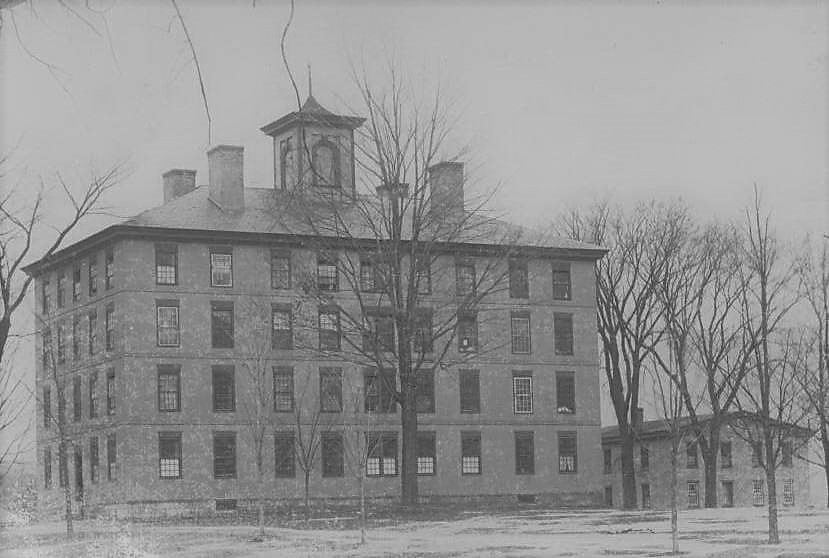
In 1855 a major remodeling of the building saw the East-West hallway replaced by non-communicating entrances at the North and South ends. The annual commencement day march through that hallway had been referred to as going “through college.”

In 1871 the brick exterior of West College was painted yellow in a “renewal of youth and freshness,” according to the Williams Vidette.
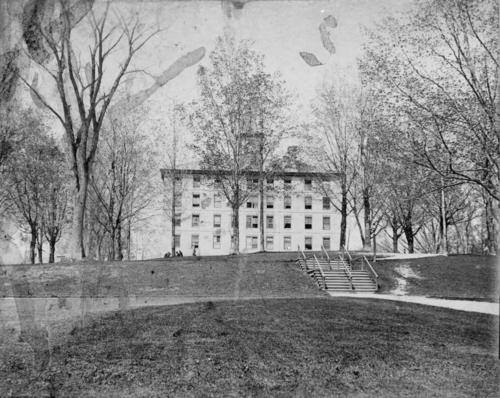
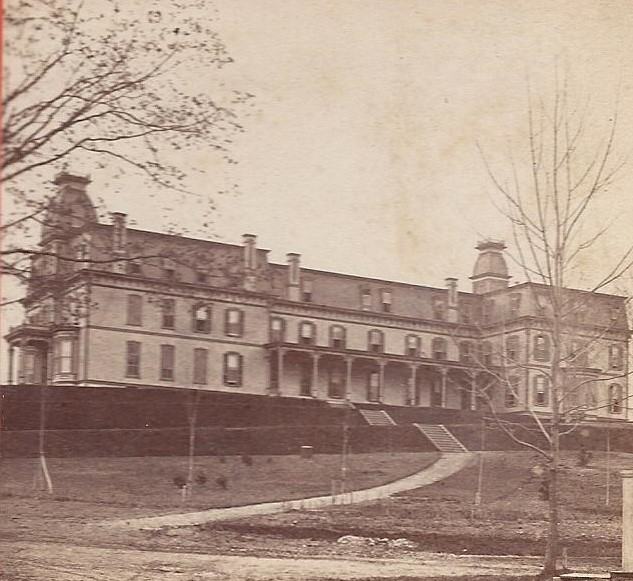
The lighter color of the building can be discerned in this 1898 photo by Alexander Davidson (original in the Williams College Archives). The Davidson photo, taken from Lab Campus Drive, shows the stairs in place before the construction of Hopkins Gate.

To West College
…For every one
Who in the past has found a home in thee,
And for the countless students yet to be,
Whom thou shalt shelter from the rain and sun,
We love thee, old West College
– J. B. Pratt (Williams Class of 1898)
Williams Literary Monthly, April 1896

The West College building was gutted right down to its brick shell twice in the 20th century.

North Adams Transcript, June 8, 1904

In 1904 everything except for the exterior walls was demolished and rebuilt with “all the necessities and luxuries of a College dormitory” according to the Williams Record, although one letter-to-the-editor judged the renovation: “as dangerously threaten[ing] the democratic spirit in Williams College.”
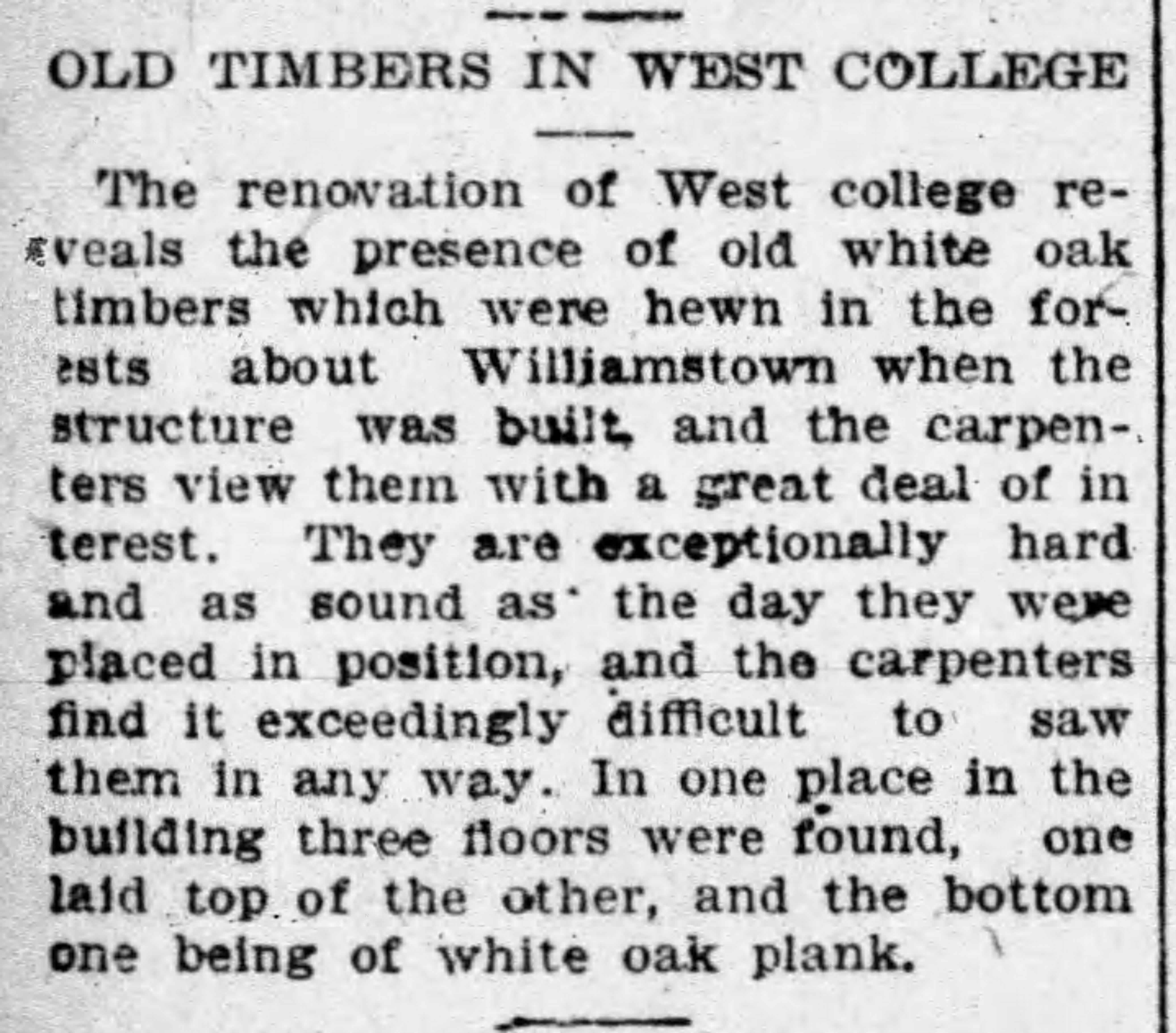
North Adams Transcript, July 1, 1904

In December 1904, fire escapes were placed on the building.

In 1928, after 57 years, the yellow paint was finally sand-blasted off the brick exterior.

Then on January 2, 1951 a devastating fire gutted the building. Three students who had returned early from vacation escaped with their lives, and all the residents lost their belongings.
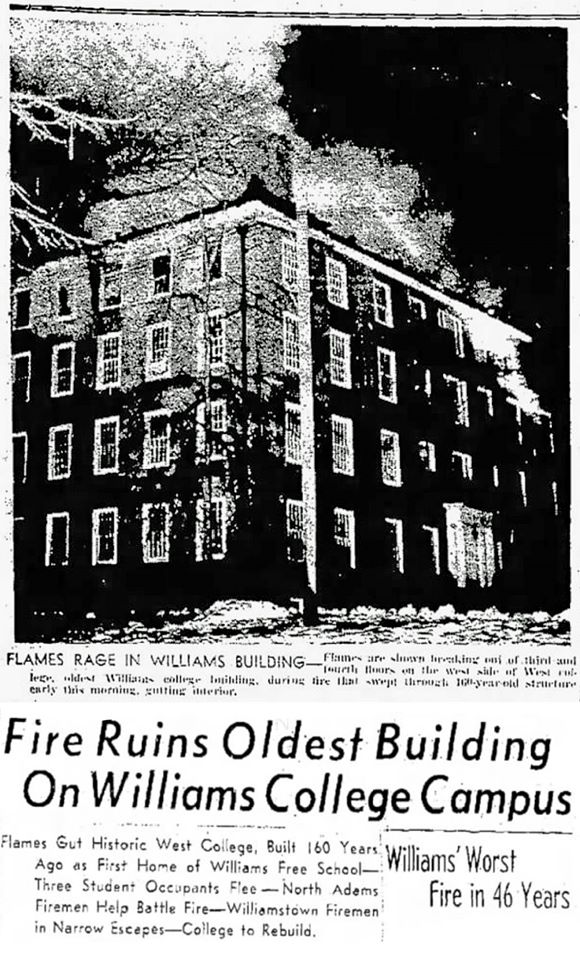
North Adams Transcript, January 2, 1951

The $225,000 renovation wasn’t complete until the 1952-1953 academic year. The architectural firm Perry, Shaw, Hepburn, Kehoe, and Dean assured the North Adams Transcript that from the outside, the building looked “exactly as it was in 1790.” Inside, there were fireproof stairways, rooms for 48 upperclassmen, and a vault in the basement for College records.

A “West College Room” built from salvaged timbers, was added to the Alumni House, now known as The Log.

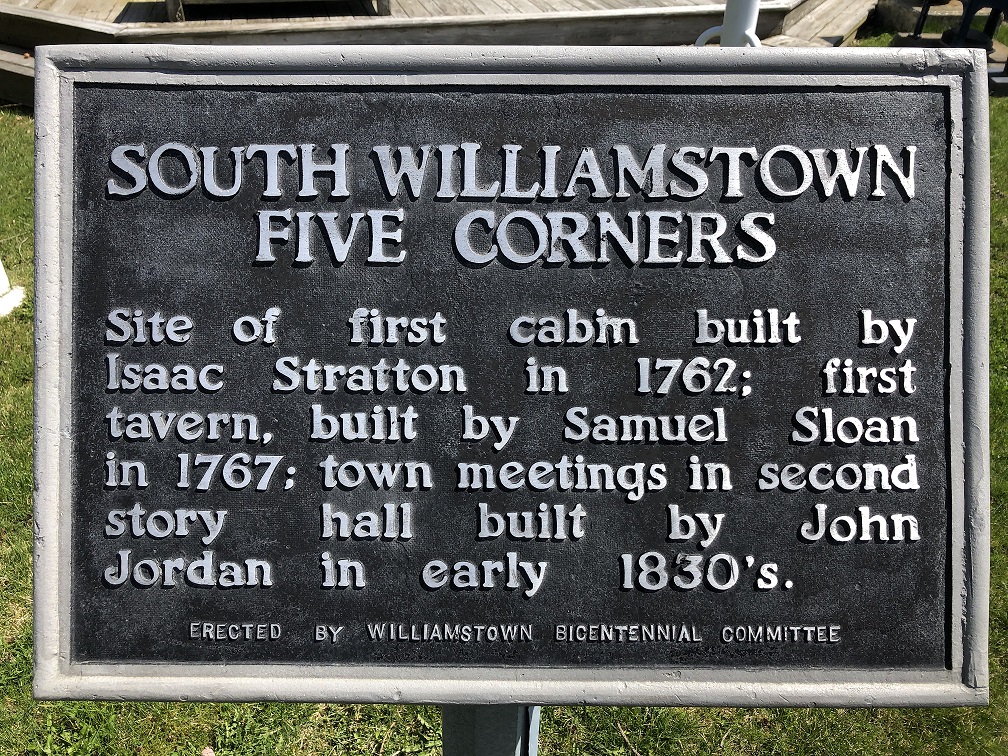
Can you find the historic site marker for West College and the building? If you find it, please photograph the marker, the building and anything around it and email your photos to info@williamstownhsitoricalmuseum.org so we can add your images to our collection of recent photographs of historic sites in our ever changing town.

If you would like to visit other sites in this series, click on the button below.  Please be safe, enjoy yourselves, and have fun!

Historic Marker Scavenger Hunt
 

Discover Historic Williamstown! Week 3

Historic Site 3. South Williamstown Five Corners

This week’s historic site marker is located in the center of South Williamstown at the Five Corners.

The Sloan, Stratton, Jordan, Phelps, and Steele families are just a few of the folks who made the “south part” the vibrant community it remains today.  We invite you to explore the Web site of our friends at the South Williamstown Community Association to learn more about the area yesterday and today. https://southwilliamstown.org/

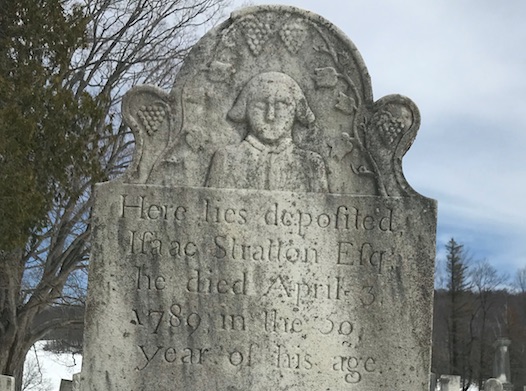
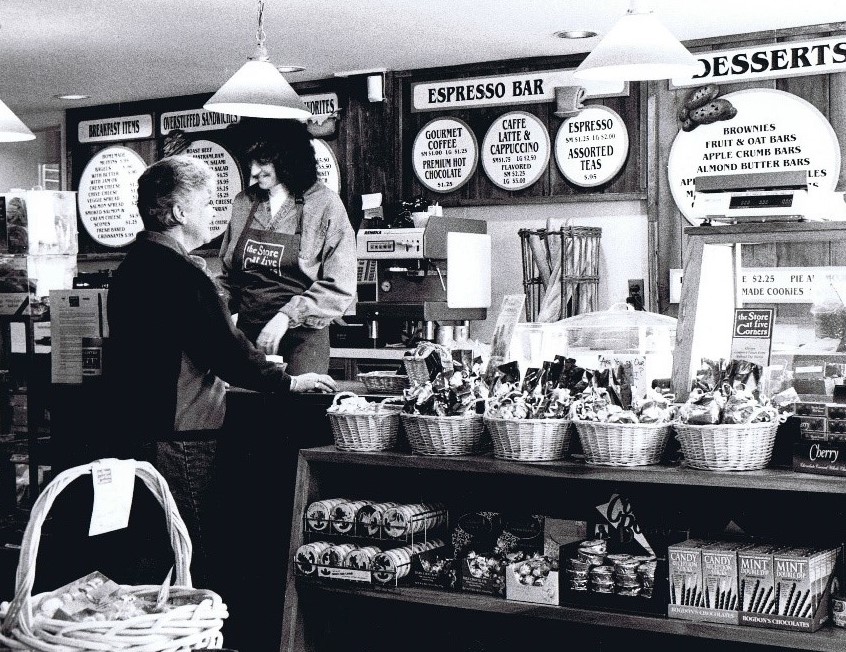
Isaac Stratton, South Williamstown’s first European settler, was born in Warren, MA, in 1739 and moved to Williamstown with his parents and seven siblings in 1760. In 1762 he built his first cabin on the site of the The Store at Five Corners, which he subsequently sold to Samuel Sloan.

Stratton served as Justice of the Peace and had an illustrious military career, distinguishing himself as a Major in Colonel Simonds regiment at the Battle of Bennington.

Isaac Stratton married Mary Fox in 1761 and they had at least five children. They are buried together in Southlawn Cemetery.

Regina Rouse delivered this excellent presentation “Honoring Isaac Stratton” for us back in 2018. We encourage you to watch for a detailed account of this important founding member of our community.

Honoring Isaac Stratton Video

The Five Corners Historic District, encompassing the central district of South Williamstown, was listed on the National Register of Historic Places in 1993. It is centered at the junction of Cold Spring Road (Rt. 7 north), Green River Road (Rt. 43 northeast), Hancock Road (Rt. 43 southwest),New Ashford Road (Rt. 7 south), and Sloan Road. The junction has been a prominent center in the area since 1760.

South Williamstown was formed out of the junction of four large parcels of land, and developed in the late 18th century as a stop on the main north-south stagecoach route (today United States Route 7). By the turn of the 19th century the village had a tavern, store, and cemetery, and the first church was built in 1808. The area remained agricultural through the 19th-century, having been bypassed by railroad construction and significant industrial activity.

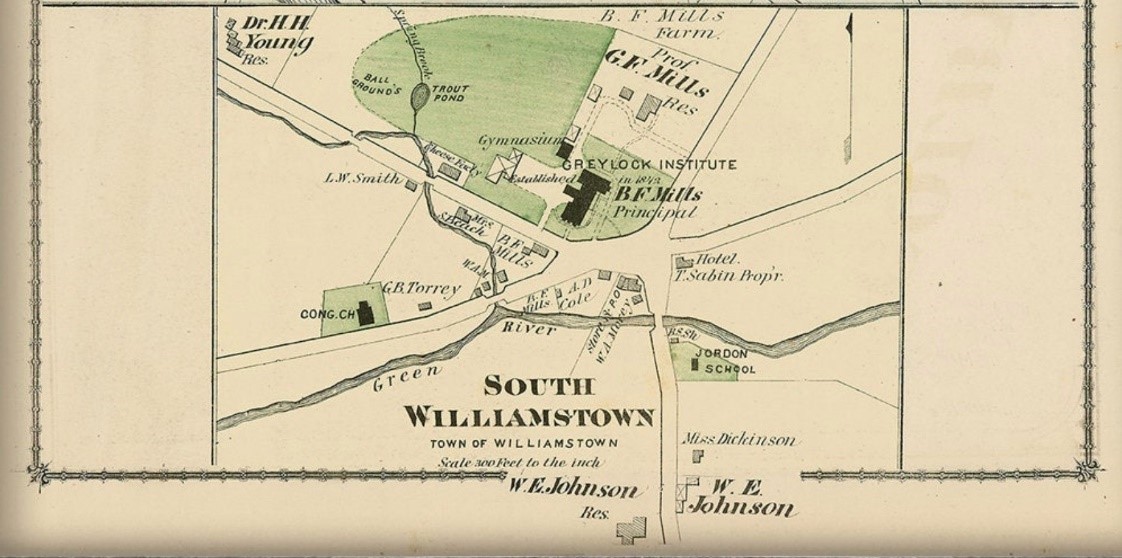
Map of South Williamstown in 1876.

A History of the Store at Five Corners

Isaac Stratton built the original building, a log cabin, in 1760, then Samuel Sloan built a tavern on the site in 1770 where it became a gathering place for Colonial troops, including a brief stop-over by General George Washington.

Nathan Rossiter

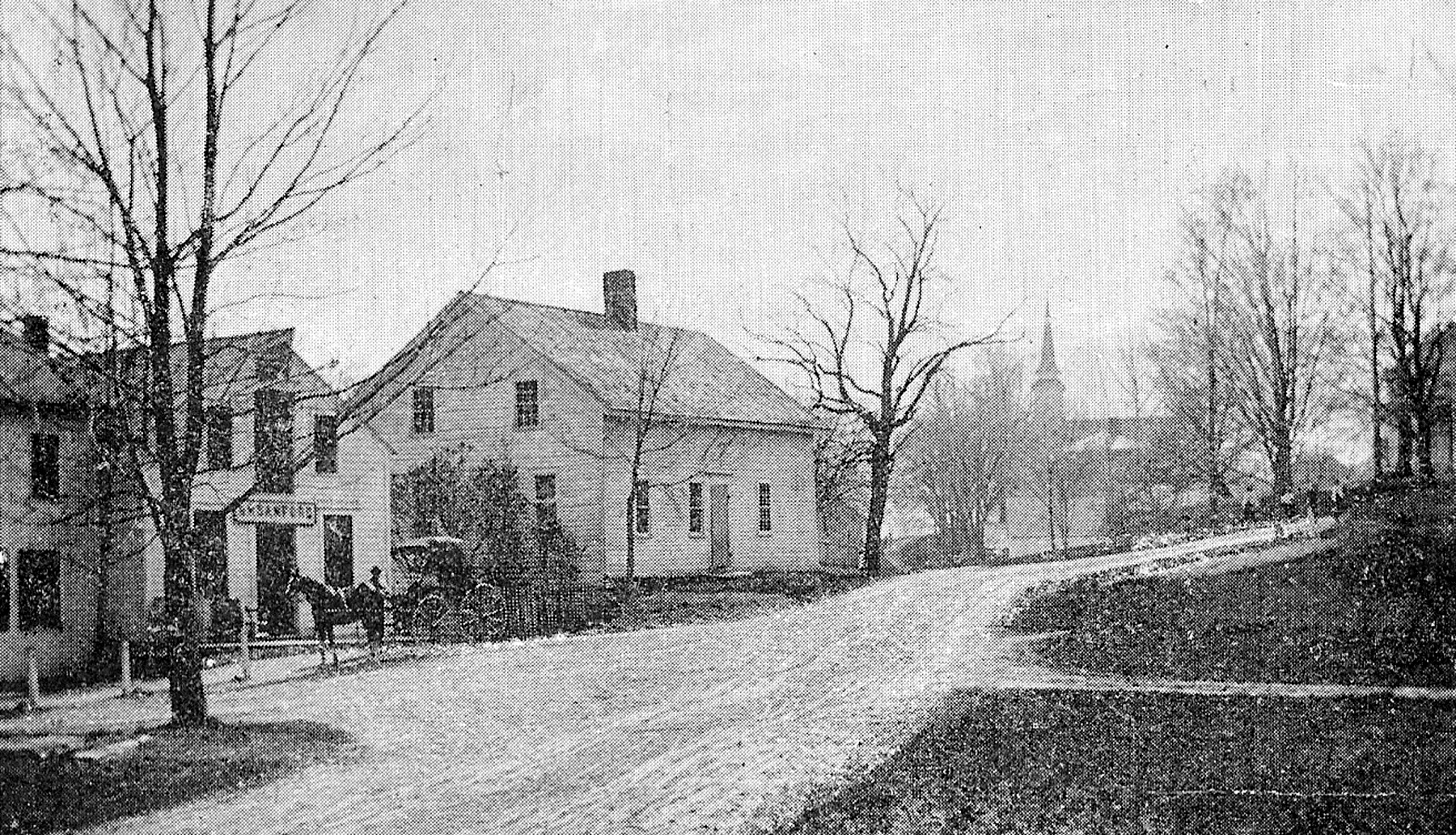
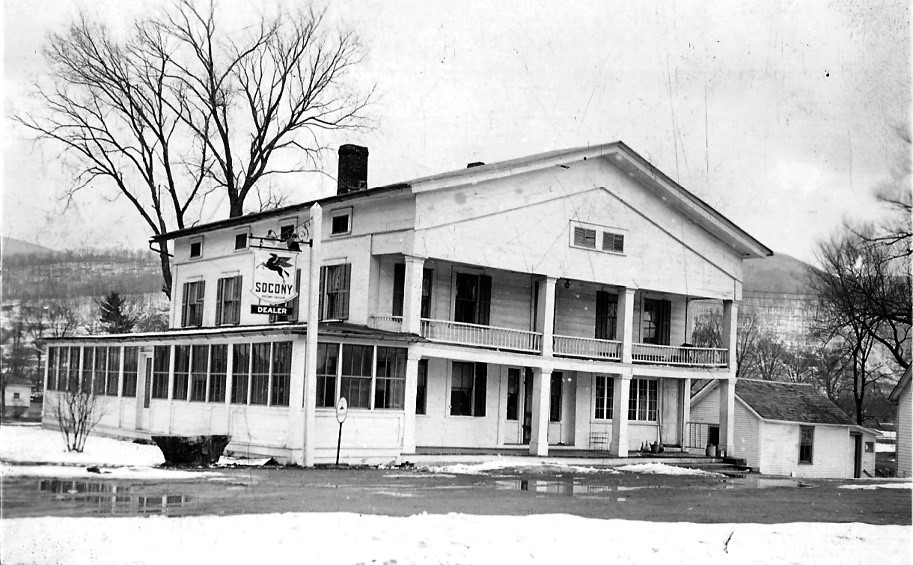
In 1816 Nathan Rossiter had a tavern on the site. As Jordan’s Tavern, under the ownership of John Jordan from 1833-65, the second floor and Greek Revival portico were added. After two changes of ownership, in 1875 Thomas Sabin gave it the name Sabin House and conducted it as an inn.

While the Mills School was in existence just up the hill, the tavern was a haven for parents and visitors. Business took a hit with the closing of that school in 1889.

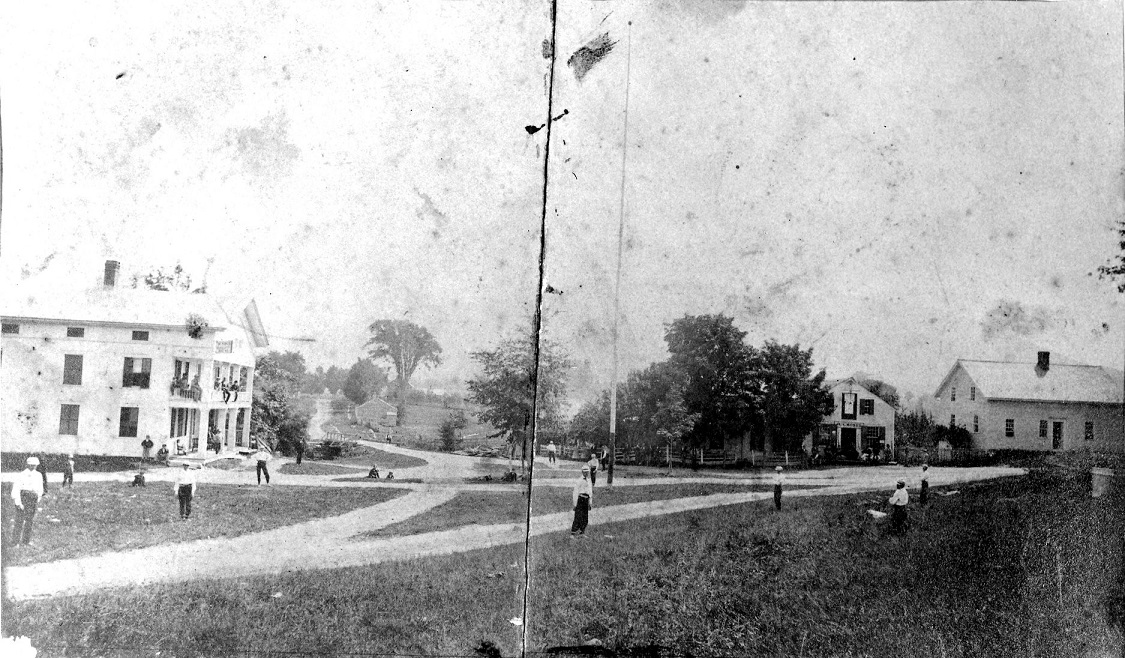
Photo of the Five Corners in 1880, featuring students from the Mills School.

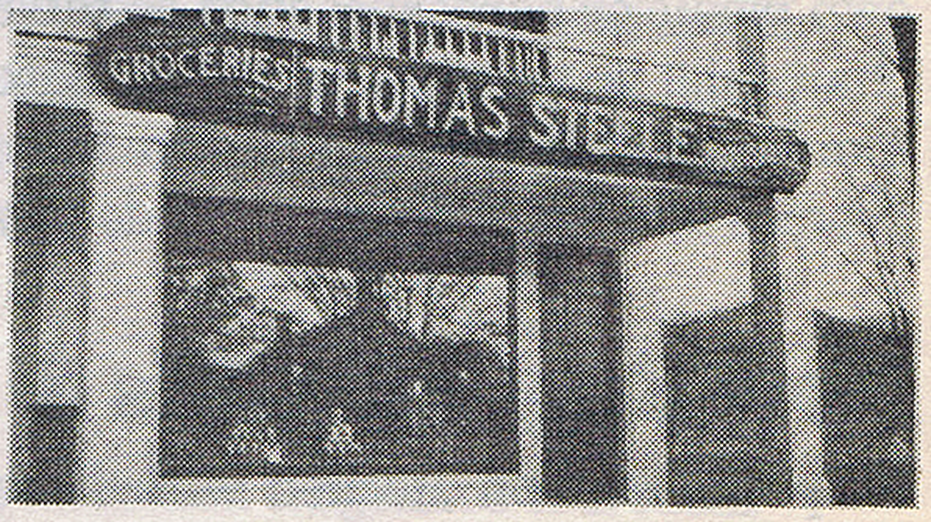
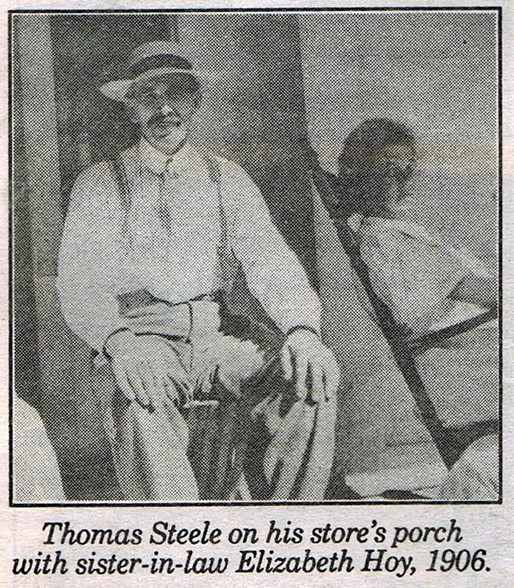
In 1905 Thomas and Jane Hoy Steele and their ten children moved from Shushan, NY, and bought the Sabin inn for use as a family home. They lopped off a wing of the building and had hauled north on Green River Road by teams of horses. Eventually the Steeles started selling bread from their home and the Steele’s Corners Store was born.

Images from the Berkshire Eagle

Jane Steele ran the South Williamstown Post Office from the Store from 1916 until her death in 1930. The branch was closed the following year.

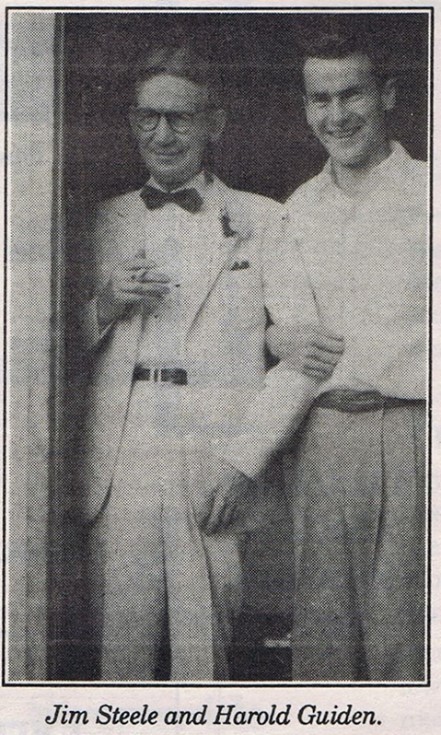
James A. “Jim” Steele took over the operation of the Store after his mother died and operated it until his death in 1963.

In a 1992 article in the Eagle, neighbor Harold Guiden remembered the Store being the hub of the community in the 1930’s and 1940’s, when “South Williamstown was a long ways from anywhere,” and going into Williamstown seemed as big a trip as going to Pittsfield.

Image from the Berkshire Eagle

The Store opened when Jim Steele got out of bed in the morning and closed when he retired at night, Guiden recalled. All day long there were at least a half-dozen people gathered around, drinking Cokes and shooting the breeze.

Jim Steele’s generosity was legendary, and he helped many members of the community during the Great Depression. Children of that era have fond memories of buying penny candy and ice cream and hanging out at the Store. Many teens had their first jobs working for Steele’s.

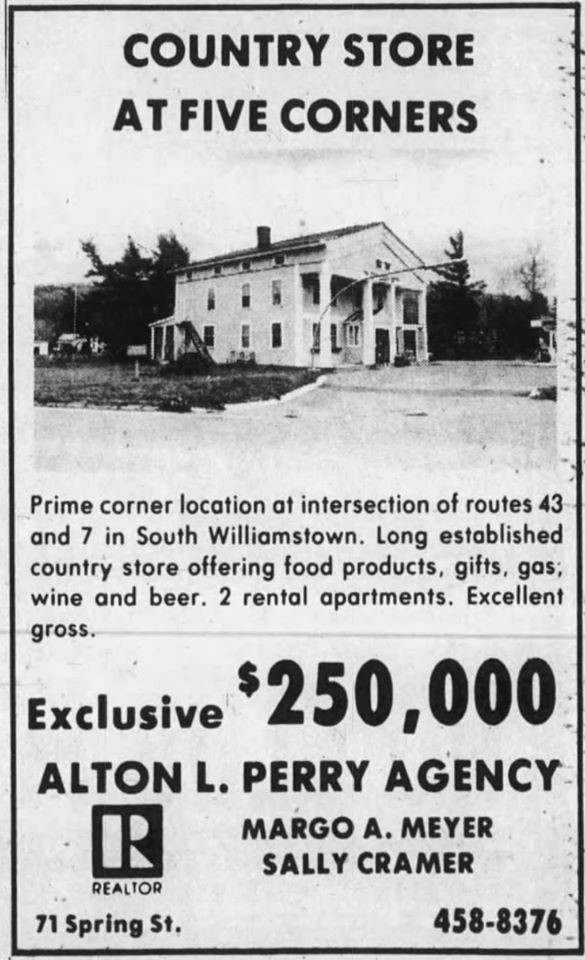
After Jim Steele died in 1963 his widow, Susan, leased the Store to Janet and Carroll Cummings, before selling it to William H. and Helen Cook Vanderbilt in 1978. The Vanderbilts renamed Steele’s Store the Store at Five Corners, removed the upstairs porch and expanded the sales room. While William Vanderbilt, the former Governor of Rhode Island, was known to pump gas for visitors, the Cummings remained as managers.

William Vanderbilt died in 1981 and Helen Vanderbilt put the Store up for sale in 1984. A year later she sold it to Patricia and Dr. Roger Gould, and Bernard and Cecelia Bandman, who also retained Janet Cummings as manager.

In 1987 the Store was up for sale again. Bryan and Donna Livsey appear to be the owners in 1990. Then in April of 1992 Stuart and Andrea Shatken purchased the property, holding a grand reopening in May with State Senators Jane Swift and Shaun Kelly cutting the ribbon while the Mt. Greylock Regional High School Band played.

The Store flourished during the five years the Shatkens owned it, being featured in Gourmet magazine. In September of 1998 they sold to Meredith K. and Jeff Woodyard, who replaced all the windows and added a deck and enclosed dining porch.

In July of 2009 the Store passed into the hands of the current owner Franklin C. Lewis, who also purchased the abutting Green River Farms property. In January of 2011 he closed both businesses, marking the first time in more than a century that the Store had been out of business.

The South Williamstown Community Association attempted to purchase the Store to operate it as a non-profit entity but couldn’t come to a sales agreement with Lewis. Lewis briefly reopened the Store in 2012-2013, after which it remained closed for another two years.

Since 2015 the Store has been open for business under various managers.

If you have found the marker we encourage you to take a photo of it and the surrounding Five Corners area and email it to us at info@williamstownhistoricalmuseum.org.  We are grateful for our members and friends who help build the collection of historic photos of Williamstown!  Thank you!