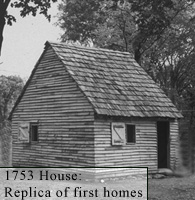
1753 House

1753House

The 1753 House

in the Rotary

In 1750, village lots in the newly surveyed West Hoosac plantation were first offered for sale by the General Court of Massachusetts Bay Colony. The Court probably had two motives in establishing the plantation: to settle and fortify the northwest corner of the colony, lying along a heavily used Indian path (now called the Mohawk Trail), and thereby protect towns to the east and south; and to prevent Dutch settlers in New York from inching over their eastern boundary into Massachusetts. The area was a heavily forested wilderness and, although some of the lots were purchased by speculators, many were acquired by soldiers from Fort Massachusetts — four miles to the east — the last outpost on the northern line of defense during the French and Indian wars.
In 1753 the General Court ordered that settlers were required to build a home on their land. The regulations stated that in order to gain title to a lot, settlers were required to clear five acres and construct a house measuring at least 15 by 18 feet with a 7 foot stud, and a chimney. It was these requirements that gave the name “regulation house” to these early buildings. It was the intention of the government that these permanent houses would provide a basic structure to live in that could easily be expanded to make a larger building. Two men helping each other could build two regulation houses in three to four months. The first meeting of the Proprietors took place on December 5, 1753, at which time there were about a dozen frame “regulation” houses along what is now West Main Street.
The early years were difficult for the settlers. The French and Indian War brought fear of ambush, scalping, and arson, and in 1756 a blockhouse and stockade, known as Fort West Hoosac, were built at the site of the present Williams Inn, as a refuge from repeated Indian raids.
After 1760, with the coming of peace, settlers flooded in, principally from Connecticut. Land was cleared and agriculture became the main source of livelihood. More land farther east on Main Street was divided and cleared, some roads were cut, and farming became the dominant way of life in the valley. Small saw, grist, and fulling (cloth making) mills were built. Professionals and craftsmen began to arrive: a doctor, a lawyer, cobblers, carpenters, blacksmiths, and shopkeepers.
In 1765 West Hoosac was incorporated as Williamstown. It was named for Col. Ephraim Williams who had commanded the northern line of defense and who, in his will, left money for the founding of a free school in West Hoosac, provided that the name of the settlement be changed to Williamstown. The school opened in 1791 and became Williams College in 1793.
In 1953, during the town bicentennial, a group of people determined to build a replica of these regulation houses, and using only tools and practices that would have been used to make the original houses, constructed the house you see on Field Park today. It belongs to the Williamstown Historic Museum and is known simply as the “1753 House”.
Cluett Estate/Pine Cobble School

Pine-cobble

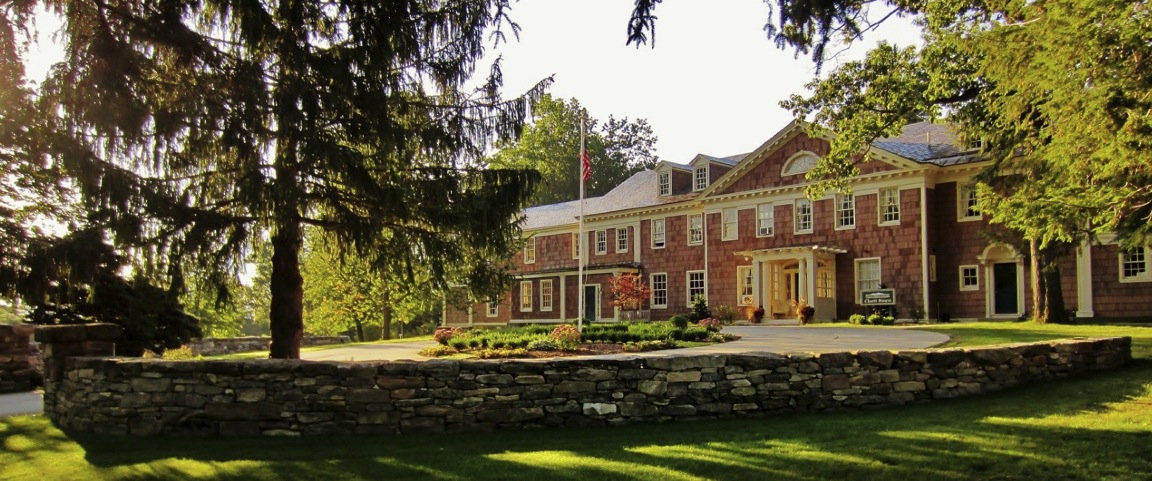
Cluett Estate/Pine Cobble School (163 Gale Road)

This home was built in 1911 as a weekend and summer home for George Alfred Cluett, and is an example of the high Georgian style. The original landscape was designed by Olmsted Associates in 1911. Olmsted Associates, founded by Frederick Law Olmstead, designed over 60 projects in Berkshire County. Cluett was born in Troy NY, and joined his father and uncle in the successful collar and shirt factory which later become Arrow Shirts.
By the turn of the century, Williamstown had become a popular summer resort, and George’s father, Robert Cluett, had built a Georgian revival home at the top of Gale Hill that the family called Southfield (which still stands). After his father died, George became president of Cluett, Peabody, and Company, which later became Arrow Shirt. Several members of the large Cluett family had homes in Williamstown. Cluett raised Guernsey cattle, Clydesdale horses, and Norwegian Elkhounds.
George became a discerning collector of antiques. He bought examples of the work of the finest cabinet makers, including three McIntire sofas, two signed Seymour tambours, and a signed Lannuier pier table. He also owned the “outstanding representation of Duncan Phyfe [furniture] anywhere today,” this from an article in the November 1954 issue of the magazine “Antiques”. This issue was entirely devoted to the homes of seven distinguished collectors, including the “outstanding collection of American Federal furniture” owned by the George A. Cluett family. Helen Comstock, who wrote the piece on the Cluett collection, noted that the “the house is a work of art in itself,” and provided the perfect backdrop for the rarities that Mr. Cluett collected. The images in the magazine “Antiques” confirm this observation and show Cluett’s treasures arranged in beautifully detailed rooms, surrounded with fashionable scenic wallpaper, elegant curtains, and oriental rugs.
He later used the Williamstown estate as a summer home, and Sea Island, Georgia, which he purchased from the late playwright Eugene O’Neill, became his permanent home. He died in 1955 and is buried in the Williams College cemetery. In 1960, Cluett’s children, George Alfred, Jr. and daughters Emily and Edith, loaned almost 90 pieces from their father’s furniture collection to Historic Deerfield. Other pieces may be seen at the Museum of Fine Arts in Boston and the Sterling and Francine Clark Art Institute in Williamstown.
Williams College acquired the property, and eventually David and Joyce Milne purchased it to create the Highcroft School. Highcroft was run by the Milnes from 1978 to 1993.  The early Pine Cobble School building was in the former Sabin mansion, Thornwood, at Field Park. Sadly, in January 1970, it was destroyed by fire. Subsequently, a modern building was erected to replace it. In the mid 1990s, there was a three way trade: The Milnes closed the Highcroft School and sold the buildings to Pine Cobble School; Pine Cobble School moved to the Cluett Estate; and the former Pine Cobble school building was given to the Milnes, which they in turn donated to the town for both the new library and the Williamstown Historical Museum.
The Cluett estate is in very good, original condition, though additions have been added to the south (back) and west sides of the building.  The rooms have beautiful molding and original fireplaces. Original ornate ceilings can also be found in several rooms.

Reverend Seth Swift House

WHMQuinn house center 

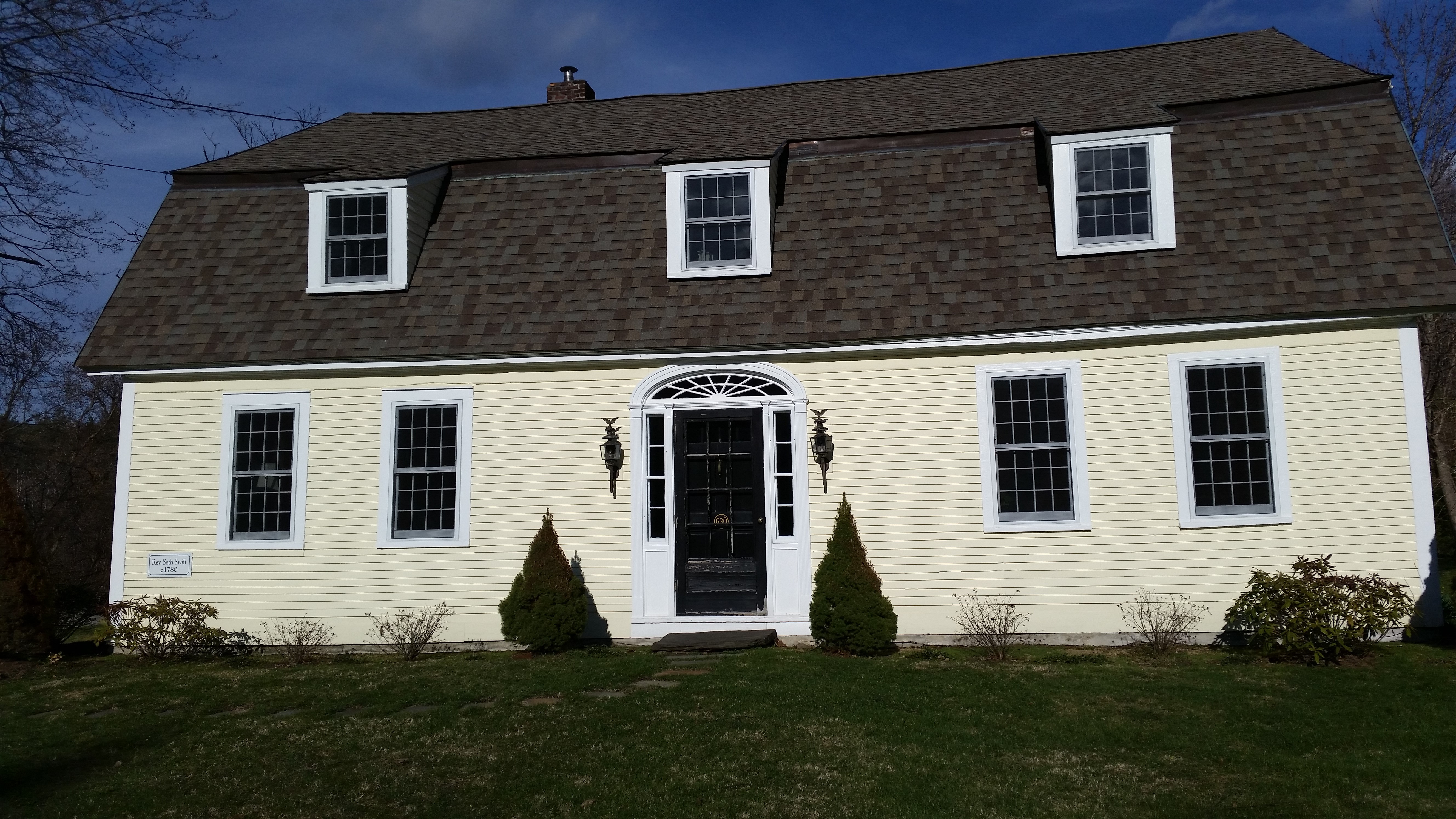
Reverend Seth Swift House (630 Water Street)

This home was built by the Reverend Seth Swift in 1780. Rev. Swift was one of the original trustees and the first treasurer of Williams College. He was ordained to the ministry at the First Congregational Church in 1779, was married in 1781 and had his first child in 1782. During his long tenure as pastor the church grew from 63 member to 273 members. Robert R.R.Brooks says in Williamstown: The First 250 Years: “The handsome, almost massive lines of the gambrel roofed house….testify to the minister’s skill in supplementing by farming his meager earnings as a pastor.” He sold the house in 1799 to Almond Harrison. He then bought the Federal period house (still to be seen diagonally northwest across the street – 575 Water Street) in order to have more spacious accommodations for his wife, Lucy, and their seven children.
The house has seen much change in its 235 years. Early in the 1900’s it was converted to a duplex in order to house workers from the Cluett Estate. When the current owners purchased the house in 2007, there were still two side by side staircases in the front hall. The distinctive fanlight and side lights over the front door were probably added after the Cluetts purchased the house. Unfortunately, all the fireplaces were removed as they were not efficient heating sources and simply took up space. The front hall had several layers of flooring which the current owners removed. They were able to salvage as many of the original floorboards as they could, including the use of floorboards from the attic. The thick hand planks bordering one side of the front hall are indicative of the post and beam style of construction. There are also plank walls on both the exterior and original interior walls.
The living room still retains much of the original plaster walls and chair rail. The plaster was removed from the study and family room at some point, and the beams and framing were exposed. Today, one can see the chestnut post construction, including the wooden pegs. Most of the original wide boards on the first floor have been covered over. The staircase is not original, and the original configuration has been lost to time. The second floor retains several bedrooms with the impressive original wide plank flooring.
The house sits on a stone foundation and has a cellar under about one third of the house. Construction of old houses was often done from existing native timber on site. They would dig a saw pit for sawing the timbers then build the house around it. The outside of the house has retained much of its original character, although the garage was added sometime in the 1960’s or ’70’s.
The current owners have found no treasures during their restoration, but did come up with numerous old hand forged nails. The only scrap of paper was found in the attic authorizing a Mr. Stevens to be the representative for the sale of a magazine in the late 1800’s. The Stevens family owned the property for several generations and operated it as Pine Tree Farm, named for two old pine trees (which no longer exist) planted in front of the house by Seth Swift.