
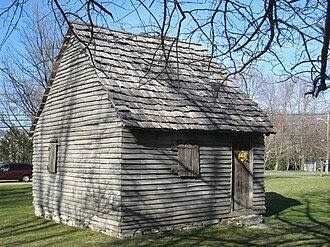
Located in Field Park at the northern intersection of Routes 2 and 7, the 1753 House is a replica of an eighteenth-century European settler’s regulation house, a small dwelling built to meet requirements established by the Massachusetts Bay Colony for settlers claiming land in the West Hoosac plantation, the settlement that would eventually become Williamstown.
West Hoosac and the regulation houses
Williamstown occupies the ancestral homelands of the Stockbridge-Munsee Mohican Community, whose relationship with this land long predates European settlement. In the mid-eighteenth century, the Massachusetts Bay Colony began expanding its settlement into the region, which was then home to the Muhheconeew (Mohican) people.
In 1750, village lots in the West Hoosac plantation were first offered for sale by the General Court of the Massachusetts Bay Colony. Although some lots were purchased by speculators, many were acquired by soldiers from Fort Massachusetts, four miles to the east, which had served as the northernmost outpost in the region’s colonial defense during the French and Indian War.
In 1753, the General Court required purchasers to establish homes on their land. To gain title to a lot, settlers had to clear five acres and construct a house measuring at least 15 by 18 feet, with seven-foot walls and a chimney. These requirements gave rise to the term “regulation house,” referring to the modest dwellings built to meet the colony’s specifications. The houses provided basic shelter and could be expanded as families and settlements grew. Two men working together could reportedly build two regulation houses in three to four months.
The first meeting of the Proprietors took place on December 5th, 1753. By that time, approximately a dozen frame regulation houses stood along what is now West Main Street.
The expansion of colonial settlement brought dispossession and the eventual displacement of the Mohican people from their homelands. In 1756, amid the conflict of the Seven Years’ War (known in North America as the French and Indian War), a blockhouse and stockade known as Fort West Hoosac were constructed at the site of the present-day Williams Inn.
The development of Williamstown
Following 1760, additional European settlers arrived, principally from Connecticut. Land was cleared for agriculture, which became the principal source of livelihood in the valley. Farther east along Main Street, additional land was divided and cultivated, roads were established, and small saw, grist, and fulling (cloth-making) mills were constructed. European-American professionals and tradespeople also established themselves in the growing settlement, including doctors, lawyers, cobblers, carpenters, blacksmiths, and shopkeepers.
In 1765, West Hoosac was incorporated as Williamstown. The town was named for Colonel Ephraim Williams, who had commanded the northern line of colonial defense. In his will, Williams left funds for the establishment of a free school in West Hoosac, on the condition that the settlement be renamed in his honor. The school opened in 1791 and became Williams College in 1793.
The Stockbridge-Munsee Mohican Community continues to maintain its identity, sovereignty, and cultural connections to this region. The history of Williamstown encompasses not only the development of European settlement, but also the enduring presence and experiences of the Indigenous people whose homeland this has always been.
The 1753 House today
The house standing in Field Park today is not an original eighteenth-century structure. It was constructed by local volunteers in 1953, using traditional tools and building methods, as part of Williamstown’s Bicentennial observance. Intended to recreate the modest homes built by early European settlers, it has since become a familiar landmark in the community.
Today, the 1753 House is part of the Williamstown Historical Museum. The Museum recognizes that the building represents one particular chapter in Williamstown’s history, and that understanding the region’s past requires attention to the many communities whose histories and experiences have shaped this place.
For more information about the history and ongoing presence of the Stockbridge-Munsee Mohican Community, visit the Stockbridge-Munsee Community’s historical resource on Williamstown.
The house is located across from the David & Joyce Milne Public Library at 1095 Main Street. Permanent signage at the site acknowledges that Williamstown is situated on the ancestral homelands of the Mohican people.
This page was revised in November 2026 to reflect current historical research and the Museum’s evolving understanding of Williamstown’s history.