Williamstown’s First Meetinghouse

By Patricia Leach

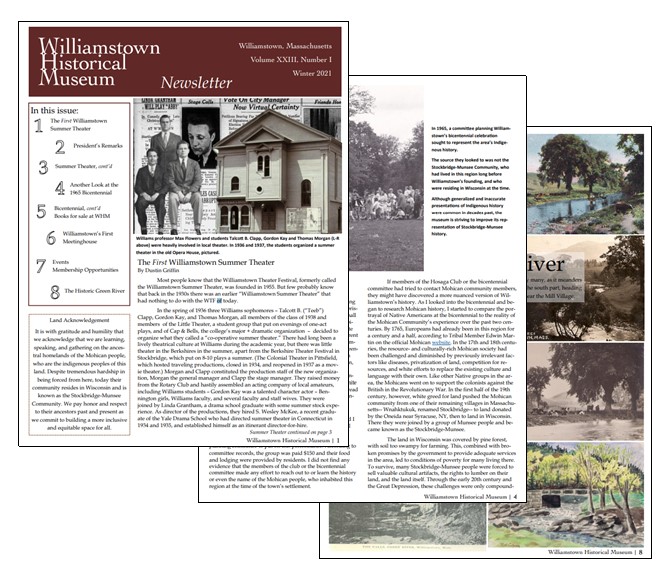
This article was published in our Winter 2021 newsletter. Read more of the newsletter here.

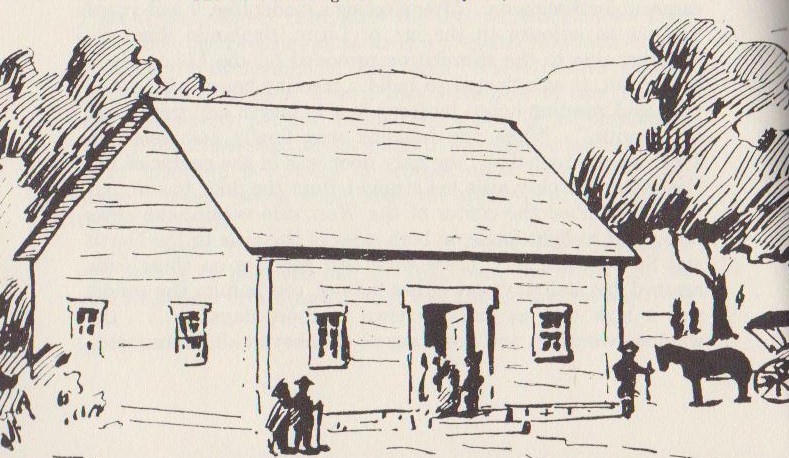
In 1765, at the incorporation of our town as “Williams Town,” there was not a true meetinghouse, per se. Services featuring our newly settled minister, Yale graduate Whitman Welch, were held in the young settlement’s log schoolhouse. But soon, as early as 1766, the need for a dedicated meetinghouse was realized. Although it  was not an expensive project—its cost was approximately $600 and many white oak trees, a primary building material, were available nearby—construction went slowly. By 1768, however, a tiny 40 x 30 ft meetinghouse was established on the Square (now known as Field Park).

As our revered Williamstown historian, Arthur Latham Perry, tells us: “Lumber was exceedingly abundant….the sills and corner-posts…the rafters and studs and braces, and certainly all the pins that in those days fastened the [white oak] timbers together….these were likely ‘sawed out at John Smedley’s mill, two miles north of the building site, along a fair road passing near what is now the Vermont line.’” While there were other local options, Smedley’s brother served on the first meetinghouse building committee and might be expected to have influenced the choice of a supplier. But what did this original little meetinghouse look like?

Perry tells us this: “The ridge pole ran north and south the longer way of the building, which was 40 feet. The roof was plain, without belfry, or tower, or other protuberance whatever. The only door was in the centre of the east side; the only aisle led straight from the door to the pulpit, which filled the center of the west side within; the pews rose up at a slight angle on both sides of the aisle to the north and south ends, which were thirty feet each; there were two galleries on these ends, reached by stairways on either side of the pulpit; the pulpit was a high one, as was universal in those days, and the preacher preached at right angles to the people; that is to say, the audience on the south side of the aisle below and above fronted [faced] exactly the audience on the north side below and above; it is no more than charity allows us moderns to infer, that the young people (perhaps the old ones too) watched each other more than they watched the minister (this author’s italics). The windows were few, and there was no chimney at all, consequently the room was relatively dark and cold; the site was high, in the middle of Main Street and at the junction of that with two cross streets, exposed to all winds in all weathers, but somewhat protected, after all, in the fact that there was no door or other opening on the west side or either end.”

The little building hosted meetings of the Proprietors as well as church services. From ca. 1795, it also accommodated town meetings (until 1828) along with “schools” in the summer until well into the 19th c. By that time the meetinghouse’s interior, which still possessed its pulpit, had degenerated into a “dark and dismal den” “peopled by spooks” according to one young scholar. And, in 1828, someone set it on fire and in no time, it lay in ashes. But even before its sorry end in the fire of 1828, it had lost its prominent position on the Square: in 1796, a new meetinghouse was proposed. And, to give this new building pride-of-place, the old meetinghouse was moved further west and pivoted around. By 1798, a new Second Meetinghouse, “more than twice the size” of its tiny predecessor, was hosting Williams College Commencement.

For more on our meetinghouses, join us for Patricia Leach’s lecture on May 29. Zoom links will be posted on our website and Facebook page.

Many Stories in the Land: Revisiting “Williamstown” and its Meanings

Many Stories in the Land: Revisiting “Williamstown” and Its Meanings—Past, Present, and Future
with Professor Christine DeLucia
Saturday, March 27, 2021, at 11 a.m.

Many Stories in the Land Lecture Video

As much as human activities have shaped the lands and waters in this area, so have the actions of more-than-human beings like the Beavers (who continue to make lodges at Field Farm). In the seventeenth and eighteenth centuries Beavers and their pelts were highly valued in trading relationships that drew Native people and tribal nations into close and difficult relationships with Euro-colonial settlers.

What does it mean to revisit the place we inhabit and seek out different, more expansive understandings of these mountains, rivers, and valleys and their deep human connections?  What might it entail to remember a place in ways that move beyond the Euro-colonial experiences that are so visibly and tangible commemorated here?

New signage at the “1753 House” site publicly recognizes this land as the “Homelands of the Moh He Con Neew (Mohican Nation),” opening a lens onto this as both a historical and continuing Indigenous place in the twenty-first century.

This presentation offers possibilities for critically rethinking both history and geography and their enduring meanings.  In particular, it recognizes vital ongoing work done by the Stockbridge-Munsee Mohican Community in their eastern tribal homelands—as well as an array of tribal-led projects across the Native Northeast—and sketches pathways for local residents to engage with and support Native/Indigenous forms of stewardship, interpretation, and sovereignty.

It simultaneously invites listeners to reconsider seemingly familiar historical documents, objects, and sites, through methods that convey more complex stories and attest to the pressures and ongoing legacies of colonization.

Most of all, this event invites dialogue about collaborative pathways for future research, learning, teaching, and action.

The 45 minute talk will be illustrated with numerous photos and documents and will be followed by a 15 minute question and answer session.


Christine DeLucia is Assistant Professor of History at Williams College, and previously taught at Mount Holyoke College.  She is author of Memory Lands: King Philip’s War and the Place of Violence in the Northeast (Yale University Press, 2018), as well as essays and articles related to the Northeast/New England, Native American communities and tribal nations, and Euro-colonial histories.  She is particularly interested in public history, memory, material culture, and the ways that people in the present interact with the past and draw upon it to shape the future.

The video may be viewed here: Many Stories in the Land presented by Christine DeLucia, lecture video

Another Look at the 1965 Bicentennial

In 1965, a committee planning Williamstown’s bicentennial celebration sought to represent the area’s Indigenous history. The source they looked to was not the Stockbridge-Munsee Community, who had lived in this region long before Williamstown’s founding, and who were residing in Wisconsin at the time. Although generalized and inaccurate presentations of Indigenous history were common in decades past, the museum is striving to improve its representation of Stockbridge-Munsee history.

By Kendall McGowan

This article was published in our Winter 2021 newsletter. Read more of the newsletter here.

As an intern getting my first experience in cataloging with the WHM this winter, I was hoping to encounter surprises in the archives.  Almost immediately, I struck upon a small mystery. It came in the form of photos of Williamstown’s bicentennial, celebrated by residents in 1965, to commemorate the town’s incorporation, which included acquiring its current name. The bicentennial planning committee arranged a number of activities, including parades, shows, and historical reenactments. Several of the  pictures I found showed people in Native American-style dress participating in the celebration, dancing, performing rituals, and constructing tepees. This puzzled me, as the event whose anniversary was being commemorated– the official naming and establishment of a white settlement— took place in 1765, in the context of a widespread colonial effort to push Indigenous peoples off their lands, including the Mohican and Munsee people in what is now known as Western Massachusetts.

My curiosity led me to carry out some research and I found that, as an apparent effort to connect to the historical presence of Indigenous peoples in the area, white students from Springfield College’s Hosaga Club were hired by the planning committee to put on this performance. According to committee records, the group was paid $150 and their food and lodging were provided by residents. I did not find any evidence that the members of the club or the bicentennial committee made any effort to reach out to or learn the history or even the name of the Mohican people, who inhabited this region at the time of the town’s settlement.

If members of the Hosaga Club or the bicentennial committee had tried to contact Mohican community members, they might have discovered a more nuanced version of Williamstown’s history. As I looked into the bicentennial and began to research Mohican history, I started to compare the portrayal of Native Americans at the bicentennial to the reality of the Mohican Community’s experience over the past two centuries. By 1765, Europeans had already been in this region for a century and a half, according to Tribal Member Edwin Martin on the official Mohican website. In the 17th and 18th centuries, the resource- and culturally-rich Mohican society had been challenged and diminished by previously irrelevant factors like diseases, privatization of land, competition for resources, and white efforts to replace the existing culture and language with their own. Like other Native groups in the area, the Mohicans went on to support the colonists against the British in the Revolutionary War. In the first half of the 19th century, however, white greed for land pushed the Mohican community from one of their remaining villages in Massachusetts– Wnahktukuk, renamed Stockbridge– to land donated by the Oneida near Syracuse, NY, then to land in Wisconsin. There they were joined by a group of Munsee people and became known as the Stockbridge-Munsee.

The land in Wisconsin was covered by pine forest, with soil too swampy for farming. This, combined with broken promises by the government to provide adequate services in the area, led to conditions of poverty for many living there. To survive, many Stockbridge-Munsee people were forced to sell valuable cultural artifacts, the rights to lumber on their land, and the land itself. Through the early 20th century and the Great Depression, these challenges were only compounded. By 1965, policy changes and community effort meant the Stockbridge-Munsee could regain some of their land and reorganize their tribal government. However, the centuries of displacement, governmental mistreatment, and resource loss that occurred between 1765 and 1965 had imparted compounding and negative consequences for the Stockbridge-Munsee. With this perspective, it is clear that there was a disconnect between the bicentennial performances and the true Indigenous history of the area which they sought to represent.

Headdresses are only worn by a few Plains tribes, and never by the Mohicans, but they were depicted in promotions of the bicentennial and at the event. The suggestion that only a generalized Native American history is available is untrue.

The white members of Springfield College’s Hosaga Club were not alone in acting out Native American stereotypes, a practice today known as “redface.” Throughout the 20th century, the practice was ubiquitous in movies, sports, Halloween costumes, and even children’s games. While many depictions were deliberately disparaging, others, like the Hosaga Club, professed to be well-intentioned. A pamphlet produced by the club states that the group was founded in 1947 in order to “study the history, ritual, art, dress and dance of native American Indians,” with the ultimate goal of “realization of the wealth to be found in [their] cultures.”  While this sounds like a well-meaning goal, portrayals of Indigenous people as exotic or foreign have long been used to justify historical and ongoing violence against them by the government. Other common misconceptions include the belief that Indigenous communities no longer have a significant presence at all, or are otherwise incapable of representing themselves, or that the diverse cultures of the 574 federally recognized tribes in the US are easily studied or interchangeable. These falsehoods can lead to cultural erasure or a denial of necessary resources or attention. When a role depicting an Indigenous person is given to a white performer instead of one from that background, they are denied not only the job but control over how Indigenous communities are presented to the world.

The WHM is committed to presenting an honest story of the region, and that story emerges over time. We are working to be thoughtful about how the history of the Stockbridge-Munsee Community is depicted at the Williamstown Historical Museum. In collaboration with the Stockbridge-Munsee Community’s Historic Preservation Office in town, we are revising our section on local Indigenous history and including more of this history throughout the museum. Every trip into our archives is capable of exciting curiosity and bringing up lessons like this one, which is why ongoing preservation and use of the WHM collection is so important!